
Due to our incendiary weather forecast, I chose to celebrate the 4th of July indoors. I attended virtually an Interfaith Service Celebrating USA at 250 from the National Cathedral, viewed the Capitol 4th on television, enjoyed grilled burgers at the home of dear friends, and watched the Macy’s 4th of July fireworks where, in their exuberance, they set the Brooklyn Bridge on fire.
Even with all that commemoration, I felt something was missing. After all, it was the 250th anniversary. I checked online at the Library of Congress and found a transcript of Thomas Jefferson’s masterpiece, The Declaration of Independence. I wanted to read it and reflect on what it took, not just to write it, but to sign it. Several sentences caught my attention, in addition to the one we best remember: “We hold these truths to be self-evident, that all men are created equal, that they are endowed by their creator with certain unalienable rights, that among these are Life, Liberty and the pursuit of Happiness.” This sentence challenged the very foundation of British society–the monarchy.
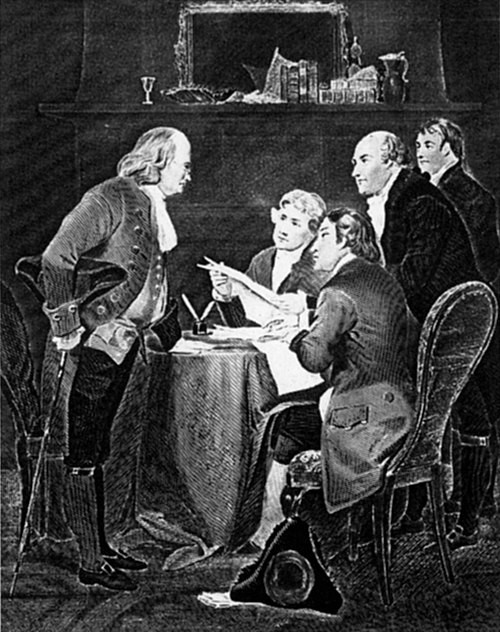
But before that, In the very first sentence, the document acknowledge that the eyes of the world are upon them.
“When in the course of human events, it becomes necessary for one people to dissolve the political bands which have connected them with another …. a decent respect to the opinions of mankind requires that they should declare the causes which impel them to the separation.”
A list of grievances follows at the end of the next long paragraph, “To prove this, let Facts be submitted to a candid world.” I counted 27 grievances against the King. It reads like the oral argument of very reasoned people.
Image from Wikimedia Commons
Then, the document explains how the colonies had tried to get the British crown to address these grievances. “We have appealed to their native justice and magnanimity, and we have conjured them by the ties of our common kindred to disavow these usurpations…They have been too deaf to the voice of justice and of consanguinity.”
Finally, the document states “appealing to the Supreme Judge of the world for the rectitude of our intentions,.. these United Colonies are, and of Right ought to be Free and Independent States.” It maintain that as free and independent states they have the full power to levy war, conclude peace, contract alliances, establish commerce. And that God, however they each knew him, knew their good intentions.
The conclusion of this document ends with support of its signers, “with firm reliance on the protection of divine Providence, we mutually pledge to each other our Lives, our Fortunes and our sacred Honor.”
Some 57 people representing each of the thirteen colonies signed this document. I am not sure how wealthy all of them were at the time, but I know that Franklin was a successful businessman in Pennsylvania, Jefferson a Virginia landowner, John Adams an attorney, and John Hancock a wealthy shipping magnate. If the colonies had lost, the British crown would certainly have seized these assets and hung the signers for sedition. Still, they added “their sacred honor” as the final phrase. They did not want to be recorded in history as rabble-rousing insurrectionists. They wanted history to remember them as people of honor.
On the 250th anniversary of that important signing, I want to remember those founders by behaving with honor. When speaking with people who don’t agree with me about our current state of affairs, I want to listen without prejudice, explain myself without arrogance, and seek to resolve differences with mutual respect. I believe this civility honors those founders of our democracy.
Cherie
Lovely reminder of the need for civility, which can look like a weakness – but as you showed it is really a strength and proof of integrity.